Notice a changed pattern
A plant that once stayed moist for several days but now dries rapidly deserves investigation. First check whether temperature or light has changed. Also notice whether growth has slowed during a period when that species normally grows actively, without automatically blaming a shortage of root space.
Roots appearing through a drainage hole are a clue rather than a verdict. Some may reach the opening before filling the entire pot. A combination of tightly crowded roots, little remaining growing medium and watering difficulties tells you more than one visible root alone.
Inspect without pulling the stem
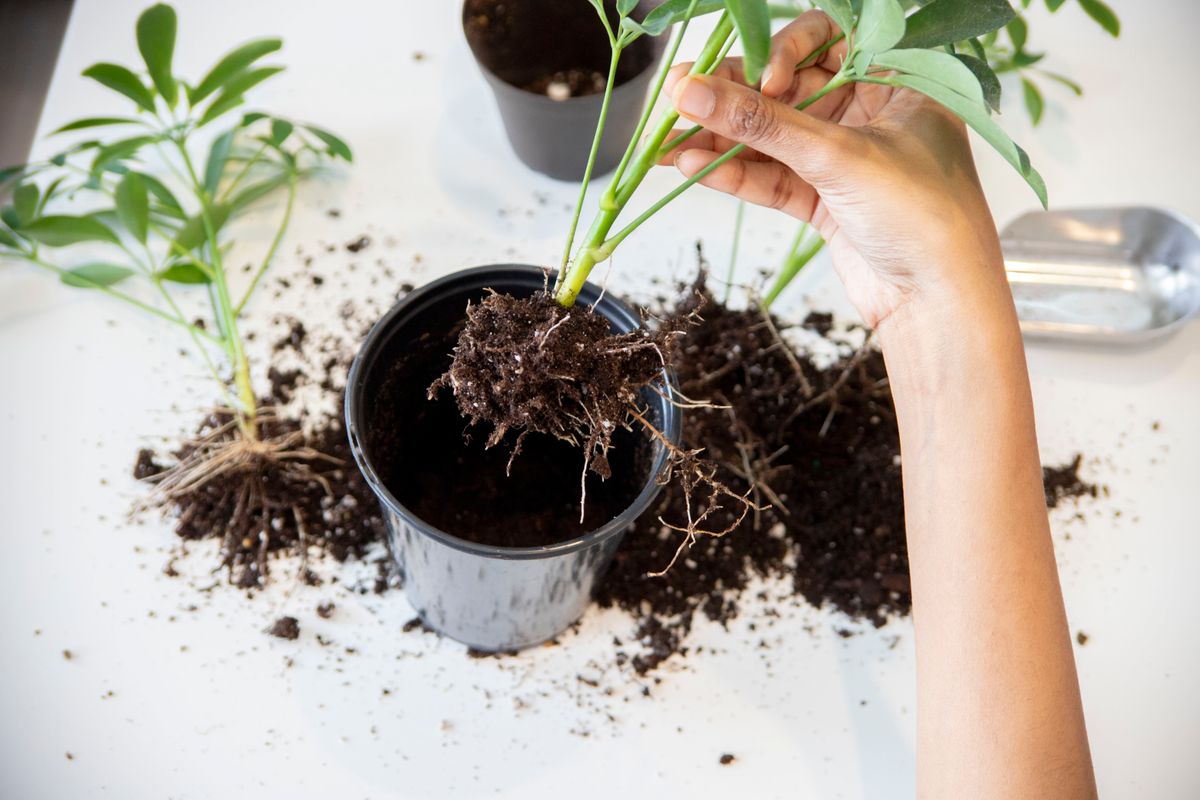
If the plant and its size allow the root ball to be removed safely, support it and handle the pot carefully using suitable guidance. Do not pull on leaves or stems. With a large specimen, seek help or advice before tipping a weight you cannot comfortably control.
Look at the distribution of roots and the condition of the mix. Soft roots, an unpleasant smell or persistently wet material suggest a different issue from a healthy root ball that has simply become crowded. Putting everything into an enormous pot does not resolve an unknown diagnosis and may make watering harder to manage.
Increase size for a reason
Check the appropriate size increase for the species. More volume does not necessarily produce better growth: excessive mix around a small root system can remain wet longer than is useful. Choose drainage and a medium intended for the plant, rather than reusing problematic material.
Before starting, prepare your surface, new pot and something to collect loose compost. Keep the plant at a planting depth appropriate to its cultivation. Do not arbitrarily bury the base of the stems to make it stand firmly, or press so hard that the growing medium loses its structure.
Review care afterwards
Watering after repotting depends on the plant and mix used. Do not reach for fertiliser by reflex: some composts already contain it, and a recently handled plant does not automatically need another intervention. Observe it in a suitable, stable position while its watering pattern becomes familiar again.